

Author: Seth Thomas - 5 min read
Erectile dysfunction is often talked about as if there’s one obvious solution. In reality, ED treatment is not one-size-fits-all. Different causes, preferences, health conditions, and goals call for different approaches.
Clinicians generally think of ED treatment as a spectrum. Some options focus on blood flow, others on mechanics, nerve signaling, or confidence. Many men use more than one approach over time.
Below is an overview of the most common ED treatment options, what they do, and where they tend to fit.
Oral medications
Although this article focuses on non-pill options, it’s worth mentioning that oral medications like sildenafil and tadalafil are often a first step. They work by enhancing blood flow during sexual stimulation.
They are effective for many men, but not all. Side effects, contraindications, or limited response lead some men to explore alternatives. According to the American Urological Association, it’s normal to adjust or move beyond pills if they are not the right fit.
"In reality, ED treatment is not one-size-fits-all."
Vacuum erection devices (pumps)
Vacuum erection devices are one of the oldest and most studied non-drug ED treatments.
A pump creates negative pressure around the penis, drawing blood into the erectile tissue. Once an erection forms, a constriction ring is placed at the base of the penis to help maintain firmness.
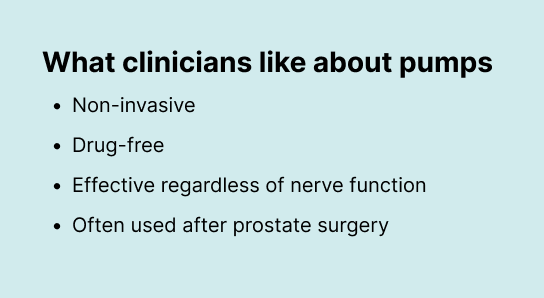
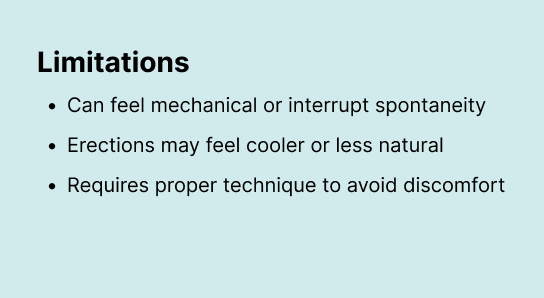
Cleveland Clinic notes that vacuum devices can be effective for many men, particularly when medications are not an option.

Constriction rings and bands
Constriction rings work by reducing venous outflow, meaning they help keep blood in the penis once an erection has formed.
They are often used:
- On their own for men who can achieve but not maintain erections
- In combination with pumps or medications

Clinicians typically emphasize proper fit and time limits when recommending rings.
Shockwave therapy
Low-intensity shockwave therapy is a newer and more debated option.
It uses acoustic waves aimed at penile tissue to stimulate blood vessel growth and improve circulation. Some studies suggest potential benefit for men with mild to moderate vasculogenic ED.
What to know
- Non-invasive
- No medication involved
- Requires multiple sessions
However, major medical organizations note that evidence is still evolving. The American Urological Association considers shockwave therapy investigational, meaning it may help some men but is not yet standard of care.
Men considering this option are usually encouraged to discuss expectations carefully with a clinician.
Topical gels and creams
Topical treatments aim to deliver medication directly through the skin rather than orally.
These may be appealing for men who:
- Cannot take oral medications
- Experience systemic side effects
That said, absorption can be inconsistent, and effectiveness varies. Some topical agents are still under investigation, and availability depends on region and regulatory approval.
Clinicians often view topical options as adjuncts rather than primary treatments.
Injection and urethral therapies
While not the focus here, injectable medications and urethral suppositories remain effective options for some men, particularly when pills fail.
They work by directly inducing smooth muscle relaxation and blood flow. These approaches are effective but require comfort with administration and proper instruction.
Surgical options
Surgery is typically reserved for men who have not had success with other treatments.
The most common surgical option is a penile implant. These devices are placed entirely inside the body and allow erections to be created mechanically.

According to Johns Hopkins Medicine, implants are usually considered only after less invasive treatments have been exhausted.
Emerging and alternative approaches
ED treatment continues to evolve, and in recent years there has been growing interest in non-pharmacologic and wearable options that support erections mechanically rather than chemically.
These approaches are designed to:
- Support firmness and durability
- Reduce reliance on medication
- Increase predictability, which can help ease performance anxiety
Because they provide physical support rather than altering blood chemistry, these options may be suitable for men with a range of underlying causes, including psychological factors or medication-related ED.
Wearable ED devices, in particular, are designed to be used discreetly during intimacy to help maintain erections once they are present. They do not stimulate blood flow or replace arousal. Instead, they offer mechanical support to help sustain firmness.

From a clinical perspective, wearables may be considered for:
- Men who prefer non-drug options
- Men using medication who want additional support
- Men who can achieve an erection but have difficulty maintaining it
As with any newer category of treatment, clinicians emphasize realistic expectations, proper use, and viewing wearables as one option within a broader ED treatment toolkit rather than a standalone solution.
"ED treatment works best when it’s viewed as a process, not a verdict."
How clinicians help patients choose
Most urologists approach ED treatment through shared decision-making. That means considering:
- Underlying cause of ED
- Medical history and safety
- Comfort with invasiveness
- Desire for spontaneity
- Long-term goals
Cleveland Clinic and the American Urological Association both emphasize that successful treatment often involves trial, adjustment, and combination approaches rather than a single perfect fix.

The Takeaway
There is no single “best” treatment for erectile dysfunction. There are many options, each with strengths and limitations.
For some men, lifestyle changes and medication are enough. For others, mechanical devices, newer therapies, or surgery provide better results. What matters most is matching the option to the person, not forcing the person to fit the option.
ED treatment works best when it’s viewed as a process, not a verdict.